
Manhattan Previous Residents by Era
One address can be researched through several time layers. ACRIS supplies the recorded-property layer from its online cutoff forward. City Register research carries the deed trail earlier. NYPL directories provide selected name and address evidence, while census, maps, and building files add a household or structure context. None of these sources should be forced to do another source’s work. A deed does not establish daily residence, and an address-directory entry does not establish ownership. Together, they build a dated trail for past residents and the property itself.
| Source | Years it covers | Where held | What it can show |
|---|---|---|---|
| ACRIS online | 1966 to present | NYC Department of Finance City Register | Recorded deeds, mortgages, liens, maps, parties, and images when available |
| City Register pre-ACRIS records | Before 1966, with book or reel reach varying | 66 John Street research facility | Older recorded instruments and reel or page references |
| Manhattan city directories | 1786 to 1934 overall | NYPL and Municipal Archives | Selective named household or business entries and address clues |
| Federal census | 1790 to 1950, subject to the 72-year release rule | National Archives and library research channels | Household members, ages, relationships, birthplaces, and occupations |
| 1890 Police Census | 1890 | NYC Municipal Archives | Address-ordered name, age, and sex entries, including children |
| DOB docket books | 1866 to 1959 | Municipal Archives building-history pathway | Applications, materials, floor count, landmarks, and building type |
| Sanborn and Perris maps | Perris 1852 to 1889; Sanborn finder 1890 to 1970 | Library of Congress and NYPL | Building footprint, use, materials, and street or block context |
Start with the source closest to the period at issue. If the question begins after the ACRIS cutoff, follow the BBL and recorded documents backward. For an earlier period, start with the City Register, NYPL, or Municipal Archives path and keep the address form used in that era.
Manhattan Previous Residents Start with BBL
A modern Manhattan address is a useful entry point, but the BBL is the connection that travels between the Department of Finance, ACRIS, planning data, and many building records. The BBL means borough-block-lot, with Manhattan as borough code 1. It identifies a tax lot, not necessarily one entrance or one household. A condo may use separate unit lots and a billing BBL. Mailing information can belong to a managing agent, officer, attorney, trust, or other account contact. Save the situs address, BBL, BIN where available, and legal description before moving backward.
Use the ACRIS address and BBL lookup to normalize the property before searching documents.
Address-to-BBL and BBL-to-address paths are useful when an older document uses a legal description or a street form that does not match the address in hand. A lot merger or subdivision can change a tax-lot number even when the same site is recognizable.
New York County Deed Chain
The recorded chain begins with the current property result, then follows party roles backward through ACRIS. Search the verified BBL and review the newest deed. Capture the grantor, grantee, execution date, recorded date, CRFN or Document ID, legal description, references, and image status. The grantee is the receiving party in a deed; the grantor is the transferring party. For the earlier purchase, search the same BBL and the prior party, then compare the legal description rather than relying on a street label alone. The same property can appear in an instrument with several parcels.
- Find the address in the DOF Property Information Portal and record the BBL, situs, current account or owner name, and mailing field.
- Search that BBL in ACRIS, narrow the results by date or document type, and open the latest deed or relevant conveyance.
- Record both parties and the legal description. Check references and image status before deciding which prior instrument belongs to the property.
- Search the same BBL and the earlier party to locate the preceding transfer. Repeat the comparison for each link.
- When the online index ends, use the City Register research facility for pre-1966 books, reels, pages, and recorded instruments.
- Grantor and grantee
- The grantor transfers an interest; the grantee receives it. Their roles can change from one deed to the next.
- Chain of title
- A dated sequence of recorded property transfers. It concerns ownership interests, not a complete list of people who lived at the address.
- Legal description
- The recorded lot or parcel wording that identifies the land. It can bridge an old street form, a partial lot, or a multi-parcel transfer.
Note: ACRIS records are public, but its online coverage begins in 1966 and should not be treated as a complete colonial-to-present title chain.
The City Register is a Department of Finance office, not the New York County Clerk. Its Manhattan office is at 66 John Street, 13th floor, and the published office hours are Monday through Friday, 8:30 a.m. to 4:30 p.m. ACRIS help is available at 212-487-6300 and acrishelp@finance.nyc.gov. For older real-property research, bring the verified address, BBL, legal-description clues, party names, and any known reel or page reference. The County Clerk remains a separate route for court files, judgments, liens, business certificates, notary matters, and archival court records.
NYPL’s Manhattan House Trail
NYPL’s house-history method joins the property trail to the building and household trail. Its guidance starts with BIS for block, lot, and original new-building information, then moves through deeds, directories, census, maps, photographs, newspapers, local histories, and Municipal Archives sources. For structures before 1900, Manhattan Borough application docket books can add materials, floors, building type, and nearby landmarks. The Office for Metropolitan History collection at NYPL adds later Manhattan building-history material for selected years.
The NYPL house-history guide shows the source sequence used to connect these records.
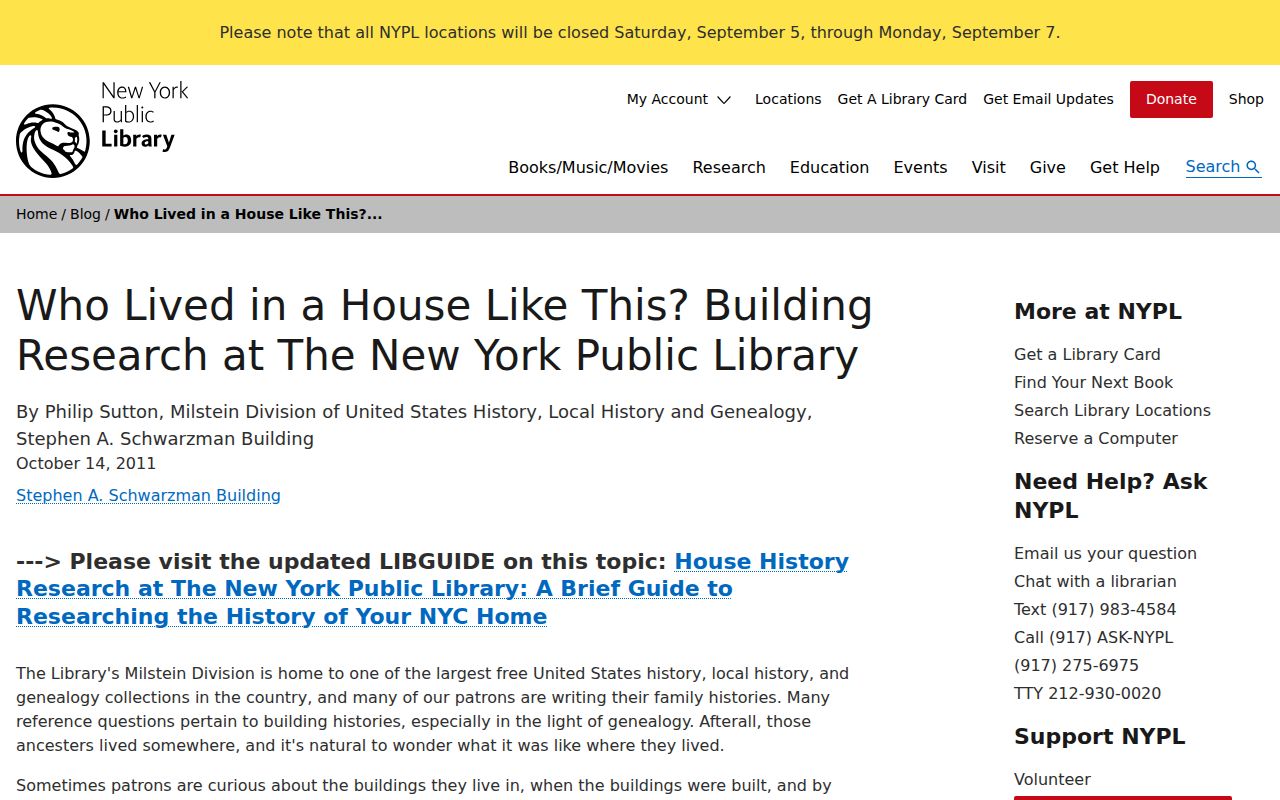
Use a new-building record or permit as a date and structure clue. It does not, by itself, identify who lived there. The Milstein Division’s catalog, microform holdings, and reference assistance provide the next route when the relevant directory or map is not digitally available.
Manhattan Past Residents in Maps
Maps help test whether two records really point to the same place. The Library of Congress Manhattan and Bronx Sanborn volume finder spans 1890 to 1970, and its 1894 Manhattan item has 98 sheets. Sanborn sheets can show footprints, materials, floors, street and block numbers, uses, fire walls, and water or fire details. Perris maps supply still earlier material. These are building and block sources, not resident lists, but they can explain why a directory address later changed shape or disappeared.
Manhattan also has two address geographies. Lower Manhattan keeps older irregular streets, ward references, and named roads, while the 1811 Randel plan laid out the numbered grid from 1st Street north to 155th Street. Compare cross streets, old map labels, BBL, deed descriptions, and DOB records when a prior address does not match a modern number. No official citywide table of every renumbering was located.
Note: Record the map edition, sheet, and street form beside every address finding so the next source can be checked against the same period.
Manhattan Previous Residents and Census
Past residents are usually found by pairing an address-based directory result with a household source. The ordinary city directory starts from a name; a reverse or criss-cross directory starts from a street and number. NYPL holds the city, telephone, business, and address-directory layer, with a broad city-directory run from 1786 to 1934. An entry may be selective and may use initials, a spouse or widow notation, a business, or an abbreviation. Read the front matter and the publisher’s key before treating one printed line as a complete household.
- Normalize the address for the target year, preserving street spelling, direction, cross streets, ward, and number form.
- Search the address or reverse directory in the target year and nearby editions. Note each surname, occupation, and address detail.
- Check the alphabetical directory entry for each candidate and compare any move, spouse, business, or street notation.
- Pair the result with the nearest released federal census, using an enumeration-district map if the address is not indexed.
- Confirm the identification through probate, a death notice, a recorded deed, or another source tied to the same period.
The collection years, formats, and access routes are covered more fully in the Manhattan city directory collections. A recurring surname is a research lead, not conclusive identity proof.
1890 Manhattan Address Census
The 1890 Manhattan Police Census is an unusual address-first source. It records name, age, and sex, including children, and can be especially valuable when a directory lists only a head of household or a business. It is arranged by address rather than by a modern name search. The Municipal Archives does not provide a mail search for this census, so a researcher may need an in-person or archive-assisted route. Its address order makes it a strong midpoint between a street directory and a broader household record.
Municipal Archives holdings and NYPL research channels also help with historical vital records, maps, newspapers, photographs, court or Common Council materials, and selected city-directory runs. An absent online result may be a custody, scanning, or indexing issue rather than evidence that a record never existed.
Limits for Manhattan Past Residents
Property records document land interests and recorded parties. Directories and census records offer time-specific household evidence, but neither is a complete account of everyone connected to an address. Current certificate access is controlled by the relevant custodian and eligibility rules. Protected voter records, Address Confidentiality Program participants, sealed matters, private building records, utility accounts, and delivery information are not substitutes for a historical address trail. A missing result can also stem from an online cutoff, spelling variation, a changed street form, or an unscanned record.
Lawful use. Use Manhattan house and family-history records for personal, lawful research, estate questions, or civic history. Never use a past-address trail to stalk, harass, intimidate, or harm anyone.