
Manhattan City Directory Holdings Across Years
New York Public Library and the Municipal Archives preserve overlapping, rather than identical, historical shelves. The broad NYPL city-directory collection spans 1786 through 1934 in print and microfilm, with later telephone books added to the research layer. The Municipal Archives lists particular Manhattan runs from 1873 through 1913, then selected volumes through 1933. Those different paths matter when a desired year is absent from a scan. Use the catalog and a librarian to match a digital item, a reel, or a shelf copy before treating a gap as a lost record.
| Directory collection | Years represented | Where held | How to consult it |
|---|---|---|---|
| New York printed directories | 1786–1934 overall | NYPL Rare Books, Milstein, Digital Collections, and Municipal Archives | Public-domain scans where available; print or microfilm onsite |
| Municipal Archives Manhattan runs | 1873–1913; 1915–18; 1920, 1922, 1924, 1931, and 1933 | NYC Municipal Archives | In person or research inquiry; no mail search for the directories |
| City and state microform directories | New York through the 1930s; wider reels 1861–1965 | NYPL Milstein Microform Rooms 119 and 121 | New York material is self-service onsite; request other cities |
| Telephone directories | Dates vary, with broader NYPL holdings around 1883–2010 | NYPL Milstein and General Research collections | Catalog or onsite request; individual editions vary |
These Manhattan volumes are selective reference works, not a complete roll of every person. They chiefly list household heads and businesses. NYPL notes that women commonly appear when widowed or operating a business. The date on a cover also does not guarantee that every address was gathered at the same moment, so a line supports a dated lead rather than a full household conclusion.
Manhattan City Directory Sources at NYPL
The Irma and Paul Milstein Division at the Stephen A. Schwarzman Building brings together the directory shelf with census material, vital-index guides, maps, newspapers, telephone books, military indexes, church records, and family files. That combination is valuable when a directory gives a street but no family relationship. Some indexes remain self-service and in person, so a catalog result should be followed by a request for the relevant reel, book, or finding aid.
The NYPL digitized directory collection is the online starting point. Its tools include keyword search, a public-domain filter, title search, topic and name refinement, date issued, place, publisher, and item metadata. OCR can miss an initial or old typeface. Try a surname prefix, an alternate spelling, a street, or the issue date, then inspect the page image instead of relying only on the result list.
The NYPL Digital Collections directory screen shown here illustrates the search and filtering layer for Manhattan directory research.
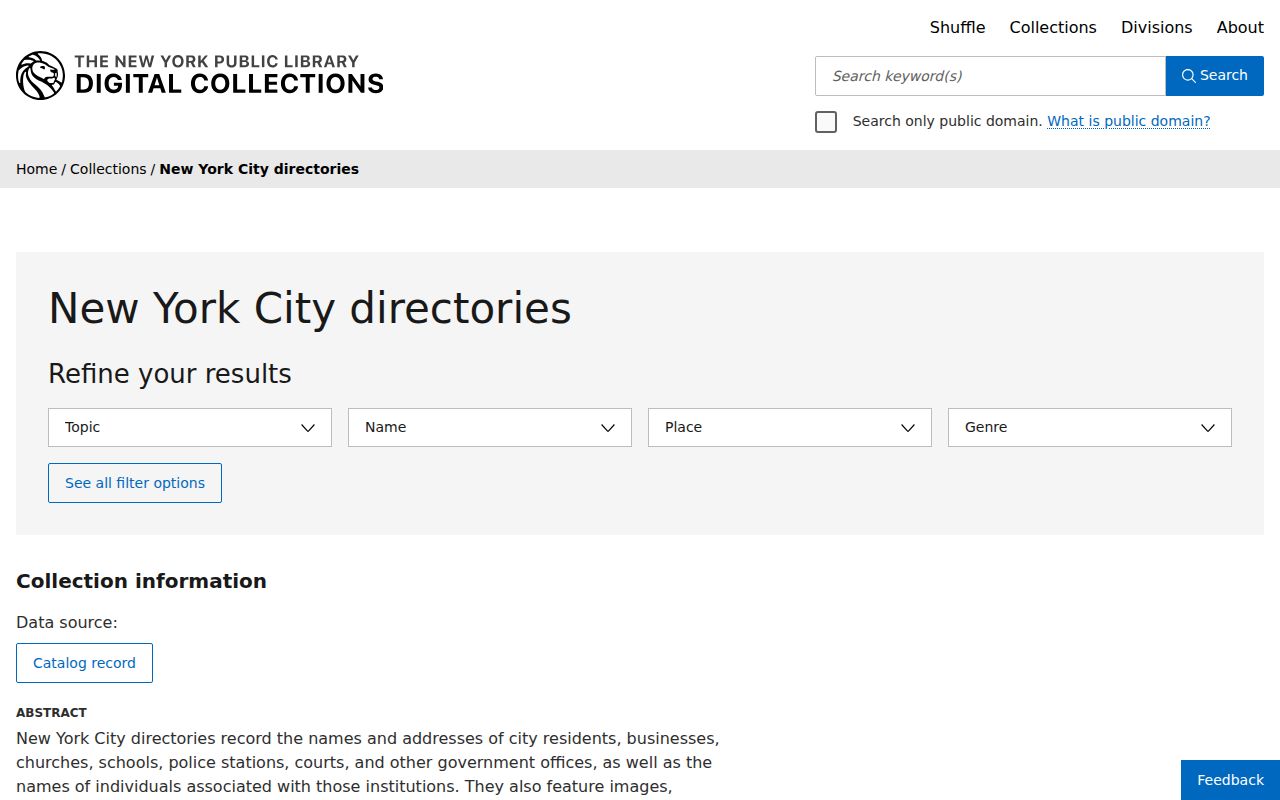
The screen helps locate a volume, but the scanned pages remain the evidence for an address, a name form, or an entry abbreviation.
Manhattan City Directory Publishers and Turning Points
Publisher changes are a practical way to organize a long search. NYPL identifies David Carroll Franks’s The New-York Directory as the first surviving printed New York volume in 1786. There was another Franks volume in 1787, but no directory has been located for 1788. Hodge, Allen, and Campbell followed for 1789–1792, then William Duncan for 1792–1795. David and Thomas Longworth produced 45 editions from 1796 to 1843, giving early Manhattan research a substantial run despite uneven household coverage.
- 1786: Franks publishes the first surviving printed New York volume identified by NYPL.
- 1796–1843: the Longworth run supplies 45 editions with addresses, occupations, institutions, and advertisements.
- 1852–about 1914: John Fowler Trow and the Trow company publish for more than six decades, including business and street components.
- 1915 onward: Ralph R. Polk acquires the Trow business and its separate components are consolidated.
- 1933/34: NYPL names the Emergency Unemployment Relief Committee issue as the last printed New York volume.
In 1886, the Trow directory reached 2,166 pages and listed 313,992 New Yorkers, according to NYPL’s history. That scale does not turn it into a census. It does show why a Manhattan volume can contain useful commercial, civic, and street context beside a person entry.
Note: A publisher change can alter abbreviations, arrangement, and coverage, so compare the volume’s front matter before carrying a conclusion into another year.
How Manhattan City Directory Lines Read
A Manhattan directory entry usually compresses a great deal into one line. Read the publisher’s abbreviation key, the business directory, and the street index before assigning meaning to a short mark. An entry can name a surname and given name, then supply an occupation, business association, street address, spouse or widow notation, and an occupancy abbreviation. The exact key changes by volume. The line is therefore a transcription target, not a modern profile.
| Name form | Surname, given name, initials, or a business name; historical spelling and initials may differ between volumes. |
|---|---|
| Occupation or business | Work or commercial context that can separate two people with the same name. |
| Street address | Home and sometimes business address; compare the street spelling and cross streets for the edition year. |
| Spouse or widow notation | A household clue that may point to a marriage, death notice, or another surname to search. |
| Occupancy mark | Only where that volume defines one; copy the mark and its printed meaning rather than guessing. |
- Criss-cross directory
- An address-ordered directory: start with a street and number to find an occupant or business, unlike an alphabetical name section.
- Householder index
- An index organized around the named person or household head, often useful when an address is not yet known.
- Abbreviation key
- The printed explanation of a volume’s shortened terms and symbols, commonly in its front matter. Copy it with the entry.
The digitized 1800 Longworth item is cataloged by NYPL with title, alternative title, collection, names, date issued, place, publisher, library location, shelf locator, genre, extent, language, identifiers, rights, notes, and citation controls.
The catalog record establishes the item and edition. The directory image itself must be read to capture the person, address, and occupation details.
Manhattan City Directories and the Police Census
For a street-based historical problem, the ordinary alphabetical section is only one route. A reverse or criss-cross directory starts with a street and number, which can reveal a business or occupant even when a surname has been misread. Page-by-page review becomes important when OCR is weak or a large building produces many entries. NYPL’s city, telephone, business, and address-directory holdings offer this additional layer, though the catalog must be checked for the specific period.
The Municipal Archives’ 1890 Manhattan Police Census is a rare companion because it is arranged by address and records name, age, and sex for residents, including children. It has no mail-search service. An onsite visit or a research inquiry is the documented fallback. That arrangement can fill the gap left by a printed volume that focused on a household head, but it still requires matching the address to its period spelling and numbering.
Trace Families Through Manhattan Directories
A sound Manhattan directory trail works outward from one dated entry. Keep the street number, direction, ward, and cross streets as they appeared in that edition. Lower Manhattan’s older streets and wards do not fit the later grid neatly. The 1811 Randel plan, which mapped the planned numbered grid from First Street through 155th Street, can help explain why an older address does not look like a current one.
- Find the target name or address in the closest available edition and transcribe the whole line, including abbreviations.
- Check the two surrounding editions. Record changes in spelling, occupation, business address, spouse or widow notation, and a new-address note.
- Search the alphabetical and reverse sections, then list every surname at the same address rather than assuming one entry represents all residents.
- Pair the entry with the nearest released federal census. The 72-year rule means the usable census year depends on the period being studied.
- Test the identity against a death notice, marriage index, probate file, deed, or business record before treating a recurring surname as the same person.
A disappearance may mean a move, a death, a changed spelling, a change in the compiler’s coverage, or simple omission. Newspapers can supply a lead, and NYPL documents access to major New York newspaper runs. For modern parcel normalization after an old address is located, use the Manhattan street address directory rather than treating a historical street line as a current property key.
Manhattan City Directory Gaps and Name Variants
Manhattan records span colonial, county, municipal, library, and digital custodians. A missing online result can reflect an unscanned volume, an index variation, a system cutover, or a protected record. It does not establish that the underlying paper never existed. The New York County Clerk describes archival series reaching back to the late 1700s, while other municipal and court series follow different custody histories. Use the system date as well as the event date when choosing the next repository.
Names deserve the same patience. Historical directory entries can use initials, anglicized forms, transliterations, a widow convention, an occupation label, or a business in place of a full household name. Modern guidance also notes that Mc and O’ names may be indexed with or without spaces or apostrophes. Try an alternate order, first letters, a spouse, an occupation, and the street. Keep a negative-search log so the next archive request is specific rather than broad.
Note: NYPL, DORIS, and court or City Register offices hold different series, so a negative result at one desk does not close the Manhattan research trail.
Manhattan City Directory Archive Stops Beyond NYPL
The NYC Municipal Archives is the next stop for historical vital records, printed directories, the Police Census, maps, photographs, and municipal series. Questions about its family-history material can go to familyhistory@records.nyc.gov, while collection questions may use research@records.nyc.gov. For a deeper name trail, the Historical Vital Records site offers search, browse, and ordering across its 1855–1950 collection, subject to the record’s access rules.
The New-York Historical Society research library adds manuscripts, maps, photographs, newspapers, ephemera, and family or community material. It uses a research and appointment pathway, and access can vary where material is unprocessed. The State Archives genealogy pathfinders are another useful route for land, probate, court, naturalization, military, census, and related series, but the State Archives warns that there is no universal statewide name index.
The Milstein Division local-history page shown below is the source for the library’s directory, microform, newspaper, and genealogy context.
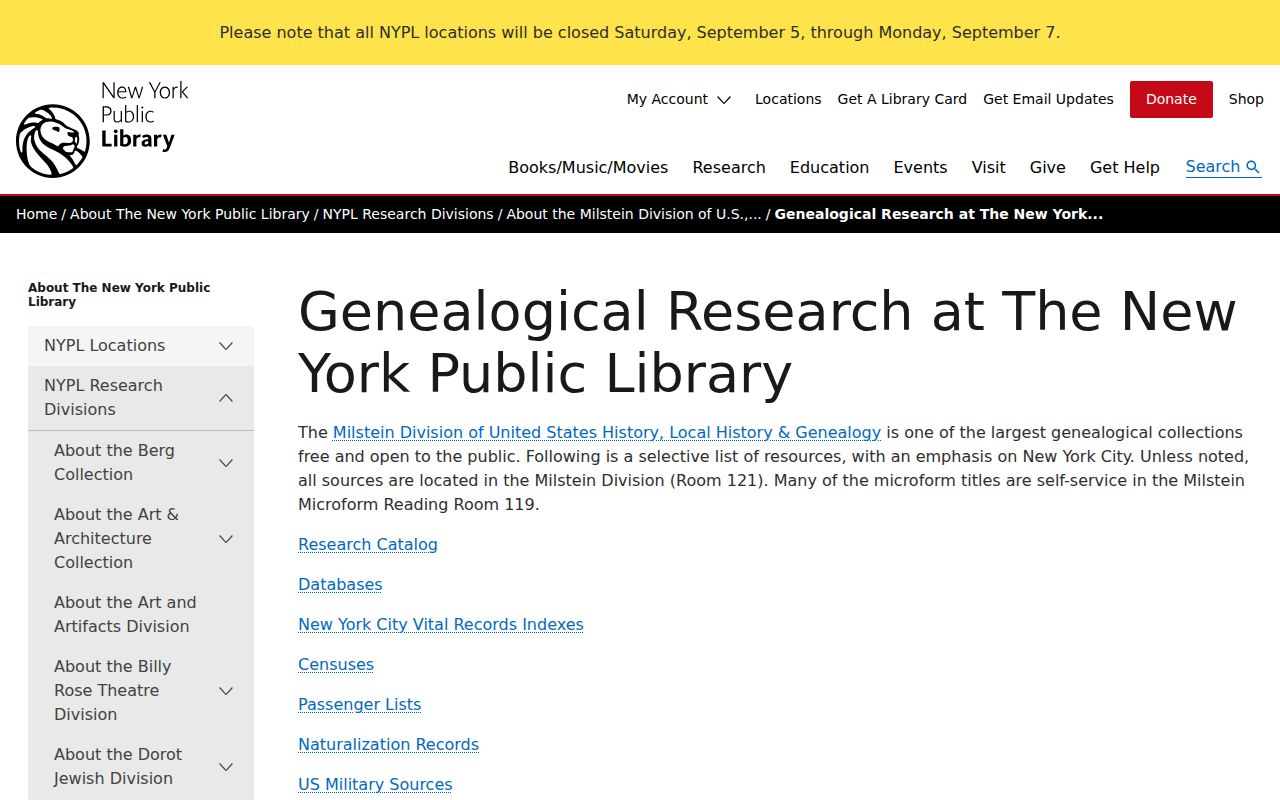
Bring the exact street spelling, borough, approximate year, alternate surname forms, and prior negative searches to an archive visit. That detail helps staff direct the request to a real record group.